A deep dive into the logical inaccuracy of the idea of the “common good”.
There is a phrase you hear every night, on television, at rallies, in the comments under every news story. It changes its clothes but the substance is always the same: “it’s what people want”, “this is good for the country”, “the voters have spoken”, “we must serve the general interest”. It is the magic formula used to justify any decision, from a tax reform to a war. And it works, because it sounds obvious: out there would be a people, with its own will and its own good, and the job of those who govern would be to listen to it and serve it.
This article takes that phrase seriously. Not with outrage — there is already too much outrage in circulation — but with the same coldness an engineer uses to check whether a bridge will hold. The question is technical but the stakes belong to everyone: does this thing, the “good of the people”, actually exist? Does it exist as a real, coherent object that can be known and served? Or is it a word we use for convenience, with nothing underneath?
Spoiler: there is nothing underneath. And it is not a political opinion saying so. It is a theorem, proved in 1951, which earned its author the Nobel Prize. The fascinating part is that you do not need mathematics to understand it. You need a dinner with friends.
The laboratory: three friends and a dinner
Anna, Ben and Chris have to decide where to eat. Three options: the pizzeria, the sushi place, the steakhouse. Nobody is cheating, nobody is acting in bad faith, and each has perfectly clear ideas.
Anna prefers the pizzeria, then sushi, and the steakhouse last. Ben prefers sushi, then the steakhouse, and the pizzeria last. Chris prefers the steakhouse, then the pizzeria, and sushi last. Three perfectly reasonable people, each with their own ranking in mind.
Now let’s do the most democratic thing in the world: let’s vote by majority, comparing the options two at a time.
Pizzeria versus sushi? Anna votes pizzeria, Chris votes pizzeria. The pizzeria wins, two to one. Sushi versus steakhouse? Anna votes sushi, Ben votes sushi. Sushi wins, two to one. Let’s pause for a moment: the group prefers the pizzeria to sushi, and sushi to the steakhouse. Therefore, by pure logic, the group should prefer the pizzeria to the steakhouse. It is the same reasoning you use when you say “I am taller than you, you are taller than him, therefore I am taller than him”. It is not a matter of opinion.
Let’s check. Steakhouse versus pizzeria? Ben votes steakhouse, Chris votes steakhouse. The steakhouse wins, two to one.
Read that again. The group prefers the pizzeria to sushi, sushi to the steakhouse, and the steakhouse to the pizzeria. It goes round in circles, endlessly, like a dog chasing its own tail. It is not a tie and it is not indecision: it is a contradiction. Each of the three friends has coherent preferences; the “group” does not. The group, as a subject that wants something, simply is not there.
This trick is called Condorcet’s paradox, after the French marquis who noticed it at the end of the eighteenth century. For a century and a half it was considered a drawing-room curiosity. It was not: it was the first crack in a wall which, as we shall see, has no foundations.
And the practical consequence is already enormous. If the group contradicts itself, who really decides where dinner happens? The decision belongs to whoever chooses the order of the questions. If I first ask “pizzeria or sushi?” and then put the winner against the steakhouse, the steakhouse wins. If I change the order of the comparisons, another place wins. Same people, same tastes, different outcomes. It is not the group that decides: it is the procedure.
Keep this in mind, because what happens at a dinner between three friends happens identically in a country of sixty million.
Method one: “most votes wins”
Let’s scale up. Ten friends, and this time each one writes a single name on a slip of paper: the most voted place wins. It is the most widespread system in the world for electing parliaments — first past the post: you do not need to pass 50%, you just need one vote more than the others.
Six of these ten friends feel like Italian food. But three write “pizzeria” and three write “steakhouse”. The other four write “sushi”. Who wins? Sushi, with four votes out of ten. Six people out of ten wanted Italian and end up eating raw fish, because they split between two similar options.
This is called the spoiler effect, and in politics it is not a curiosity: it moves history. In the American presidential election of 2000, in Florida, the environmentalist Ralph Nader gathered around 97,000 votes, almost all taken from the Democrat Al Gore, who was the closest candidate on those issues. Bush won the state — and with it the White House — by 537 votes. A handful of ballots out of six million. The “one candidate too many” won nothing, but decided who would govern the world’s leading power for eight years.

There is more, and it is the part that concerns all of us. Voters are not stupid: after seeing the spoiler effect in action two or three times, they learn. And they start doing what we call tactical voting: I give up on the one I actually prefer, because “he can’t win anyway”, and I vote for the lesser evil among the two who stand a chance. Repeated over decades, this behaviour crushes the system down to two large parties — a regularity known as Duverger’s law. Not because people love having only two choices, but because the method punishes anyone who tries to offer a third.
Let’s stop for a second on what that means. The system does not merely measure badly what we want: it changes what we are willing to ask for. Options die before they are even put to a vote.
Method two: “let’s rank them”
Someone, quite rightly, says: the problem is that you make us write only one name. Let’s do this instead — everyone ranks the places: first, second, third. This is ranked choice voting (or instant-runoff), and some countries genuinely use it.
The count is simple. You look at the first places. If nobody passes 50%, the last-placed candidate is eliminated, and the votes of those who had ranked them first pass automatically to their second preference. You repeat until someone reaches a majority. The advantage is obvious: you can vote with your heart for the one you really prefer, because if they do not make it your vote is not lost, it simply moves to your second choice. Goodbye tactical voting, goodbye spoiler.
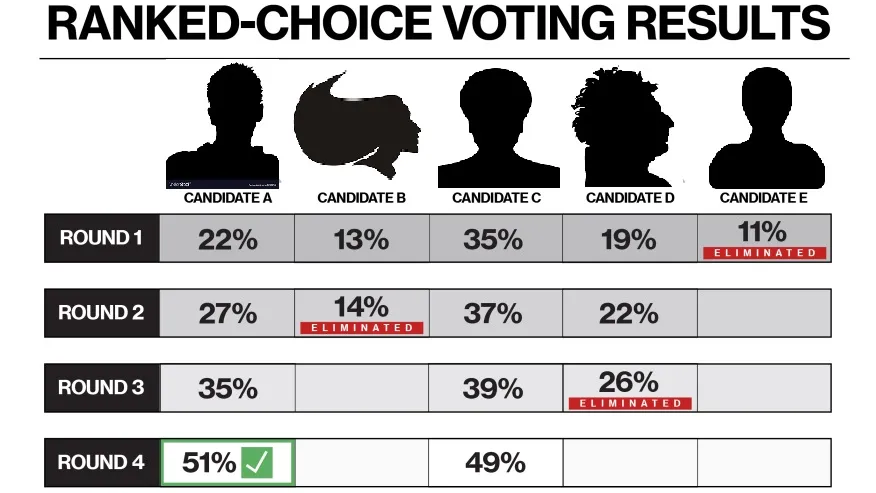
It is worth reading the diagram above carefully, because it tells more than a thousand explanations. Candidate C is ahead in every single round: 35%, then 37%, then 39%. He looks like the announced winner. But when he is left alone against A, the votes freed up by the previous eliminations pile up almost entirely on his opponent, and C loses 49 to 51. The candidate preferred by the largest number of people from beginning to end goes home empty-handed.
On this one you can still argue: it depends on what you consider “winning”, whether it is being first for many or acceptable to almost everyone. That is a legitimate choice. The real flaw of this method, however, is another one, and it is not debatable at all: getting more votes can make you lose.
It sounds like a typo, but it is not. The reason lies in that elimination mechanism. If a candidate rises in the preferences of a group of voters, it changes who gets eliminated first. And if it changes who gets eliminated first, it also changes where the transferred votes end up — sometimes all of them against him. Gaining support harmed him.
This is not a blackboard hypothesis. It happened in Burlington, a small town in Vermont, in 2009: it is the case studied in the textbooks. The candidate who won the mayor’s office would have lost if a certain group of opposing voters, instead of putting him last, had ranked him higher. More support, defeat.
A system in which popularity can damage you is not photographing anyone’s will. It is running a procedure whose outcomes nobody has in mind while voting.
Method three: “let’s give out points”
Last attempt, the most elegant: instead of eliminating, let’s assign scores. Each person ranks the places and points are distributed — with three options, 2 points to the first, 1 to the second, 0 to the third. You add them up and the highest total wins. It is called the Borda count, and it rewards whoever is liked a little by everyone instead of whoever is loved intensely by a few. It seems the fairest of the three.
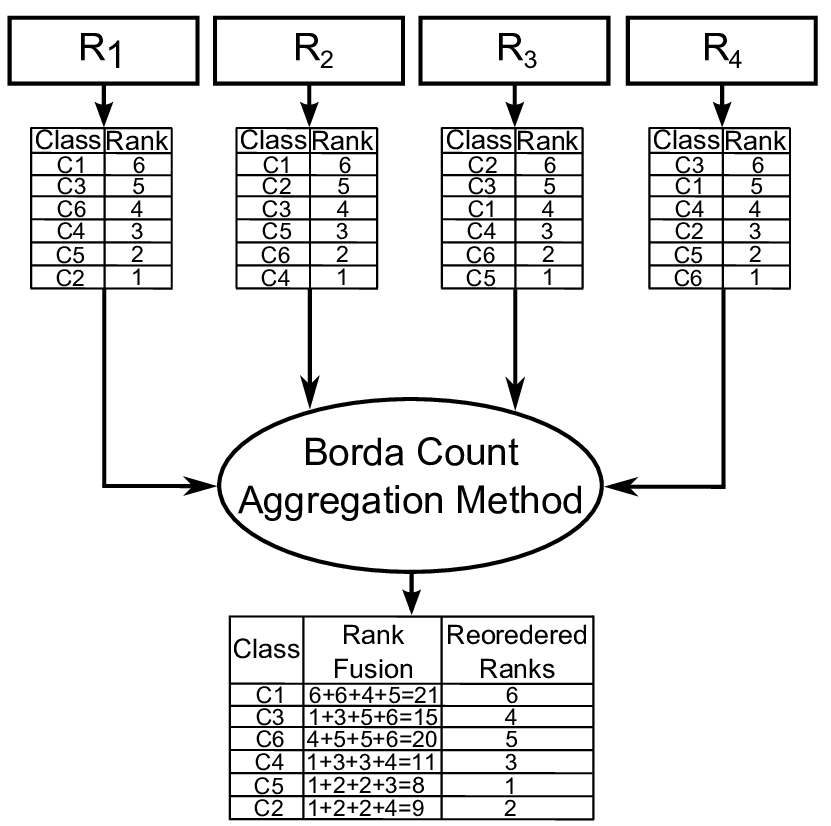
The diagram above shows the mechanism in its general form: on the left, the rankings of four different people, each with their own order; in the centre, the sum of the points each option accumulates based on the position it occupies in each ranking; at the bottom, the final result, a single ranking that none of the four had in mind. It is exactly the operation we call “collective will”: a ranking that belongs to nobody, produced by adding up everyone’s.
It has a flaw that brings down its foundations, and it is best understood with the dinner example. The group is choosing between the pizzeria and sushi, and the pizzeria is ahead. At that point the waiter mentions that there is also the house meatloaf. Nobody, not even by mistake, will ever order the meatloaf: everyone puts it last. And yet, because there are now three options and the points redistribute, the total can flip and hand the win to sushi.
Read this one again too, because it is the heart of the matter: adding an option that nobody wants changed the choice between the two that everybody wanted. It is as if the fact that the cinema is also showing a film you would never watch made you change your mind about which of the other two to see. It makes no sense, and yet the method allows it.
And it opens a dangerous door: whoever decides which options end up on the list can steer the result without touching a single vote. In politics, this means that the power to nominate is worth as much as the power to vote — sometimes more.
The twist: it is not the methods’ fault
At this point the natural reaction is: fine, we picked three mediocre systems. Sooner or later someone will invent a fair one.
In 1951 a young American economist, Kenneth Arrow, closed that hope forever. And his starting point was not voting: it was precisely the question we started from, namely whether it is possible to define in any sensible way the good of a collectivity starting from that of its individuals.
Arrow did something clever. Instead of testing methods one by one, he asked: what are the minimum requirements we would demand of any method for it to be acceptable? And he listed four, so reasonable that nobody would dispute them:
First, it must always work, whatever people happen to prefer: you cannot ban certain opinions to make the numbers add up. Second, if absolutely everyone prefers A to B, the collective result must prefer A to B — the bare minimum. Third, the group’s choice between two options must not depend on a third one that is irrelevant (the meatloaf, precisely). Fourth, there must not be a single person whose preference automatically becomes everyone’s, ignoring the others: otherwise we are talking about a dictator, not a method.
Four utterly honest requests. Arrow proved that, when there are at least three options in play, no method can satisfy them all together. Not “none of those invented so far”: none possible, today and in a thousand years. The only way to respect the first three is to violate the fourth — that is, to make the good of all coincide with the will of one.
We are not searching badly. We are searching for a triangle with four sides.
And besides, let’s face it, we all lie
There is one last layer, and perhaps it is the most human. So far we have taken for granted that everyone sincerely declares what they prefer. But we do not. The tactical voting we mentioned earlier is exactly this: we declare a preference that is not ours, because it pays off.
In the 1970s two scholars, Gibbard and Satterthwaite, proved that this is not a national defect nor a moral weakness: any reasonable method, with at least three options, can be manipulated. There is always a situation in which lying about your preferences gets you a better result than telling the truth.
Let’s put the pieces together, because the final picture is merciless. On one side we have a counting rule which, by mathematical proof, distorts preferences. On the other we have input data which, out of rational convenience, is partly false. We take falsified numbers, run them through an unfaithful method, and give the resulting number a solemn name: the will of the people.
What we can conclude (and what we cannot)
Here we need honesty, because rigour is the entire value of this argument. Nothing we have seen proves that democracy is useless, still less that one man in charge decides better. On the contrary: the only mathematical escape from Arrow’s theorem is dictatorship itself, and anyone who has lived under it knows the cure is infinitely worse than the disease. Voting remains the least bad way we have found to make decisions together without shooting each other.
What these results take away from us is not democracy. It is a sentence.
The sentence is: “this is what the people want, this is their good”. Taken literally, it does not hold up. Out there, there is no people with a single head, coherent tastes and a defined good, waiting for someone to discover it. There are millions of people with different and often incompatible ends — those are real — and there is a counting procedure that we choose, which produces a result. Change the procedure, with identical people and identical desires, and what gets proclaimed “best for everyone” changes too. The result is not a photograph: it is partly a product of the instrument we took it with.
And this is where cold analysis meets a very old suspicion, dear to those who distrust collective abstractions: people have a good, peoples do not. “The national interest”, “what the country is asking for”, “the common good” are rhetorical shortcuts, not objects that exist. And every time someone utters them they are performing a small conjuring trick: they take the disorderly sum of millions of different desires, turn it into an imaginary entity endowed with a voice, and then appoint themselves official interpreter of that voice. Arrow’s theorem does nothing more than lift the cloth and show that there is no rabbit in the hat.
Which, if you think about it, is a defence of the individual before it is a critique of the system. Because the formula “I am doing it for your own good, it is the good of all” is historically the crowbar used to justify any imposition. Knowing that this “good of all” is not a measurable object but an artefact of procedure is an excellent antibody. It is no accident that the systems doing well, and gaining trust, are the ones that do not claim to calculate any collective good at all: they merely set clear and verifiable rules, which each person decides whether to adhere to on their own, without anyone speaking on everyone’s behalf. They are not perfect. They are simply honest about what they are: procedures, not oracles.
Conclusion
Arrow’s theorem is not a pamphlet against democracy. It is something more uncomfortable: a proof. It tells us that the most used phrase in our public discourse — “this is the good of the people” — has nothing behind it, and not because of a flaw we could fix with electoral reform, but because of a limit of logic itself.
What remains are the goods of individual people, which exist and matter. What remains is the procedure by which we decide, which is useful and which we choose. In between, where we were taught to imagine a collective will waiting to be heard, there is nothing: only a number, produced by a method, dressed up as a mandate. The next time someone wins and declares that they represent what everybody wanted, you will have the tools to know exactly what they are doing. People exist, and their goods exist. The people, as a subject that wants things and benefits from them, does not.
Sources:
- Stanford Encyclopedia of Philosophy — Arrow’s Theorem
- Nobel Prize — Kenneth J. Arrow (1972)
- Wikipedia — Condorcet paradox
- Wikipedia — Duverger’s law
- Wikipedia — 2009 Burlington mayoral election (monotonicity failure)
- Wikipedia — Gibbard–Satterthwaite theorem
- FEC — 2000 Presidential General Election Results (Florida)